Small Budgets Are Beating Big Ones. That Should Not Surprise Anyone.
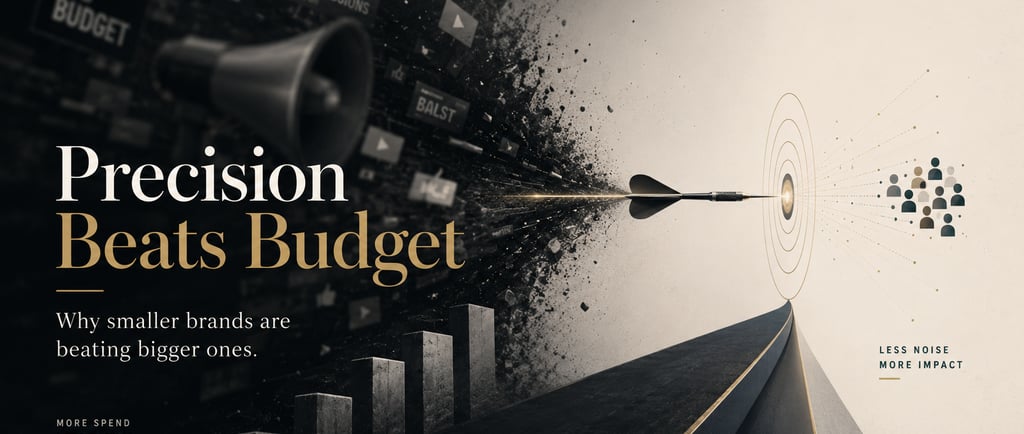
Every incumbent brand right now is looking at their media spend and wondering why it stopped working. They're not asking the right question. The question isn't why the spend stopped working. It's why they believed spend was the strategy in the first place.
Vince Calabrese
7/6/20265 min read
Marketing has spent years teaching businesses the wrong lesson.
The lesson was simple:
If you want to win, spend more.
More impressions.
More reach.
More awareness.
More budget.
More platforms.
More noise.
For a while, that looked true.
Big brands could outspend their problems. They could stay visible even when the message was average. They could cover weak targeting with volume. They could waste money and still have enough left over to make the dashboard look productive.
Small businesses never had that luxury.
They could not afford to be vague.
They could not afford to “test awareness.”
They could not afford to run bloated campaigns for people who were never going to buy.
They had to know who mattered.
They had to say something clear.
They had to follow up.
They had to make the most of every lead, every click, every conversation, every dollar.
That was not a disadvantage.
That was the training.
And now it is starting to show.
What Actually Changed
Incumbent brands are looking at their media spend and wondering why it stopped working.
But that is the wrong question.
The question is not:
“Why did the spend stop working?”
The better question is:
“Why did you believe spend was the strategy in the first place?”
Because that is where the problem started.
For years, big budgets created the illusion of control.
If performance dipped, spend more.
If leads slowed down, expand the audience.
If the campaign got stale, refresh the creative.
If the numbers looked soft, blame attribution.
But a lot of that spend was never buying growth.
It was buying comfort.
It made people feel like something was happening.
The ads were running.
The reports were full.
The impressions were high.
The agency had slides.
The marketing team had activity.
But activity is not strategy.
Visibility is not strategy.
Budget is not strategy.
And when tracking got harder, platform costs climbed, and buyers became more selective, the weakness got exposed.
The brands that depended on volume started losing efficiency.
The brands that were forced to be precise started gaining ground.
The Small Business Advantage
Small businesses do not usually win because they are louder.
They win because they are closer.
Closer to the customer.
Closer to the objection.
Closer to the phone call.
Closer to the missed opportunity.
Closer to the actual reason someone did or did not buy.
That matters more than most marketers want to admit.
Because marketing is not supposed to be a performance art for the dashboard.
It is supposed to create conversations that can turn into revenue.
A small business owner usually knows the real objections.
“They think it costs too much.”
“They do not understand the difference.”
“They wait until it is urgent.”
“They compare us to the cheap option.”
“They filled out the form but never answered the phone.”
“They said they were interested, but nobody followed up correctly.”
That is the useful stuff.
Not the vague persona deck.
Not the polished brand archetype.
Not the “customer journey” graphic with arrows and stages.
The real buyer lives in the messy details.
Small businesses are often better positioned to see those details because they cannot hide behind budget.
They feel every wasted lead.
They feel every bad campaign.
They feel every slow month.
They feel every missed call.
That pressure can either create panic or clarity.
When it creates clarity, they become dangerous.
What Precision Actually Means
Precision does not mean “better ads.”
That is where people get lazy.
They hear precision and think it means a sharper headline, a better hook, or a cleaner creative.
Those things matter.
But they are not the whole thing.
Precision means knowing exactly who you are trying to reach and refusing to spend money on everyone else.
It means your message sounds like it was written for a real buyer with a real problem.
It means your offer matches the moment they are actually in.
It means your landing page answers the questions they are already asking.
It means your CRM does not turn into a graveyard of fake opportunities.
It means your follow-up is not an afterthought.
It means your sales process is honest enough to separate real buyers from ghosts.
Most businesses do not need more leads as badly as they think they do.
They need fewer fake ones.
They need better follow-up.
They need cleaner pipelines.
They need campaigns tied to real buying behavior, not vanity metrics.
They need to stop confusing a full dashboard with a working system.
This Is How We Run Ribelle
This is the part most agencies get backward.
They start with media.
We start with the business.
Who is the actual buyer?
What do they care about?
What do they misunderstand?
What makes them hesitate?
What happens after they submit a form?
Who calls them?
How fast?
What is said?
Where do they go if they do not answer?
What does the pipeline actually mean?
How many “opportunities” are real?
How many are just sitting there making everyone feel busy?
That is where the money usually is.
Not always in a bigger ad budget.
Often in the gap between interest and action.
The small businesses we work with are not trying to become the biggest spenders in their category.
They are trying to become the most relevant choice for the people who are actually ready to buy.
That is a different game.
And it is a better one.
Because when the system is built correctly, a smaller business does not need to beat the big guys everywhere.
They only need to beat them where it matters.
In the search results.
In the inbox.
In the follow-up.
In the review comparison.
In the local market.
In the moment the buyer finally decides to act.
That is where smaller companies can win.
Not by pretending to be bigger.
By being sharper.
The Real Problem With Big Brand Marketing
Big brands often have more budget, more people, more agencies, more reports, and more meetings.
But more structure does not always create more clarity.
A lot of the time, it creates distance.
Distance from the customer.
Distance from the sales conversation.
Distance from the real objection.
Distance from the moment where revenue is won or lost.
The message gets softened.
The offer gets generalized.
The creative gets approved by committee.
The media plan gets stretched across every possible channel because everyone wants coverage.
Then performance drops and the answer is usually:
Spend more.
Test new creative.
Change the bid strategy.
Expand the audience.
Blame the platform.
But the deeper issue is usually simpler.
The brand no longer knows exactly who it is trying to move.
And when you do not know who you are trying to move, you pay platforms to guess for you.
That gets expensive fast.
The Real Shift
The next era of marketing will not be won by whoever spends the most.
It will be won by whoever wastes the least.
That does not mean being cheap.
Cheap marketing is usually expensive.
It means being disciplined.
Disciplined about who you target.
Disciplined about what you say.
Disciplined about what happens after the click.
Disciplined about tracking real opportunities instead of pretending every form fill is a future customer.
Disciplined about building systems that create revenue, not just reports.
Small businesses have been forced into this discipline for years.
They did not have the budget to hide bad strategy.
They had to make the system work.
Now the market is rewarding that.
The Big Budget Was Never the Advantage
The advantage was never having the biggest budget.
The advantage was always knowing:
Who matters.
What they care about.
Why they hesitate.
Where they pay attention.
What they need to believe before they buy.
And how to show up consistently enough that your company becomes the obvious choice.
Money can amplify that.
But it cannot replace it.
Spend is not strategy.
Volume is not strategy.
Visibility is not strategy.
Precision is.
And right now, precision is giving the small guy a real shot at beating the big guys.
That is not a trend.
That is what happens when clarity finally becomes more valuable than noise.
At Ribelle, this is the work we care about: helping smaller businesses compete with bigger ones by wasting less, following up better, and becoming the obvious choice for the buyers who actually matter.
If your marketing feels busy but not clear, that is usually where the problem starts.